Managed I.T. Services: An Essential Overview of Modern IT Management
Think about how much of your day actually depends on tech working. Email, your accounting software, the files sitting in the cloud, all that customer data you can’t afford to lose. It’s basically everything now. And keeping it secure, patched, and actually running? That’s a job on its own, and honestly most teams just don’t have the hours for it. Which is the whole reason managed IT services matter so much in 2026. If you want someone local to take this off your plate, the folks at NXT IT Solutions look after businesses right across Griffith and regional NSW with the proactive, day-to-day kind of IT management most companies need but rarely have time to do themselves.
So here’s what I want to walk through: what these services actually are, how they work, what you get, and how to pick a decent provider. No jargon. Or at least, as little as I can get away with.
What Are Managed IT Services?
At its simplest, it’s a subscription setup. A specialist provider takes on the ongoing job of watching, maintaining, and securing your tech. So instead of only ringing someone when the printer dies or the server falls over, you’ve got a partner quietly handling things in the background before they blow up.
The company doing this is called a Managed Service Provider — an MSP, everyone shortens it. And they’re not there to replace your people. They take the boring, repetitive, time-sucking stuff off your team’s hands (patching, monitoring, backups, security) so your staff can get on with work that actually grows the business.
The big shift is going from reactive to proactive. The old “break-fix” way just waits for something to break, then bills you to fix it. Managed IT services for businesses flip that — the goal is catching and sorting problems before they turn into downtime, and you pay one predictable fee each month instead of sweating every invoice.
How Managed IT Services Work
It usually runs through a few stages:
Assessment. They dig through your current setup — infrastructure, software, where the security holes are — and figure out what’s risky.
Strategy and SLA. You settle on a Service Level Agreement. That’s the document spelling out response times, what hours you’re covered, who’s responsible for what. Read it properly, it matters more than people think.
Onboarding. Monitoring tools get rolled out across your networks, servers, and every device (endpoints, in the lingo).
Ongoing management. From there the MSP keeps an eye on everything around the clock, pushes updates, works through tickets, and sends you reports on how it’s all performing.
Because the pricing is a flat, tiered monthly thing, budgeting gets a whole lot easier than the nasty surprise of an emergency repair bill.
What Managed IT Services Include
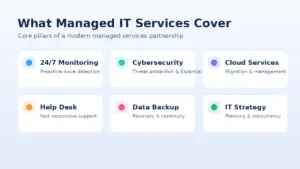
Most managed IT providers bundle a bunch of things together. The usual line-up:
- 24/7 proactive monitoring and maintenance — constant oversight so problems get spotted early and downtime stays minimal.
- Cybersecurity management — firewalls, endpoint protection, threat detection, plus frameworks like the Essential 8. NXT IT is actually Essential 8 certified, which tells you they take the security side seriously and aren’t just ticking a box.
- Cloud services — migration, configuration, and the ongoing running of cloud platforms and apps.
- Data backup and disaster recovery — automated backups and a real recovery plan, so business keeps going even when things go sideways.
- Help desk and end-user support — quick, friendly help for the everyday stuff that drives everyone up the wall.
- IT strategy and consultancy — proper guidance on planning and where to spend next. Have a look at NXT IT’s full range of IT services to see how the pieces fit.
- IT project management — structured delivery of upgrades, migrations, and rollouts, handled through their dedicated project management.
Why Businesses Choose IT Support and Managed Services
The upside goes way past just convenience.
Predictable costs. One fixed monthly fee instead of random repair bills, and less pressure to drop big money upfront on hardware or extra staff.
Access to expertise. You basically borrow a whole team — security people, cloud engineers, support staff — without having to hire each one of them yourself. That’s a big deal for a smaller business.
Stronger security. Cyber threats keep getting nastier and more frequent, so being proactive isn’t really optional anymore. A good MSP keeps your defences current and watches for trouble nonstop.
Reduced downtime. Catch things early, respond fast, and operations keep ticking — which protects both productivity and, well, revenue.
Scalability. As you grow or your needs shift, the service stretches with you. Adding users, sites, whatever, without the whole thing grinding to a halt.
Focus on core work. When the tech just… works, your team spends their time on customers and growth instead of wrestling with something that won’t load.
Managed IT Services vs Break-Fix Support
| Factor | Break-Fix | Managed IT Services |
| Approach | Reactive (fix after failure) | Proactive (prevent failure) |
| Cost | Unpredictable, per-incident | Predictable monthly fee |
| Downtime | Higher | Minimised |
| Security | Ad-hoc | Continuous |
| Relationship | Transactional | Long-term partnership |
Given how tangled and fast-moving IT environments have gotten, the proactive managed route is usually the smarter call — and cheaper in the long run, even if it doesn’t always feel that way month to month.
How to Choose the Right Managed IT Provider
When you’re weighing up managed IT providers, keep an eye out for:
- Proven local experience, and references from businesses in your region or industry.
- Clear SLAs with actual defined response and resolution times, not vague promises.
- Solid security credentials — Essential 8 alignment is a good sign.
- Real 24/7 support, not “24/7” that quietly means business hours only.
- Room to scale as you grow.
- Transparent pricing you can actually plan around.
The best providers stop feeling like a vendor and start feeling like part of your own team. If you want to talk through what you need, you can contact NXT IT Solutions for a free consultation.