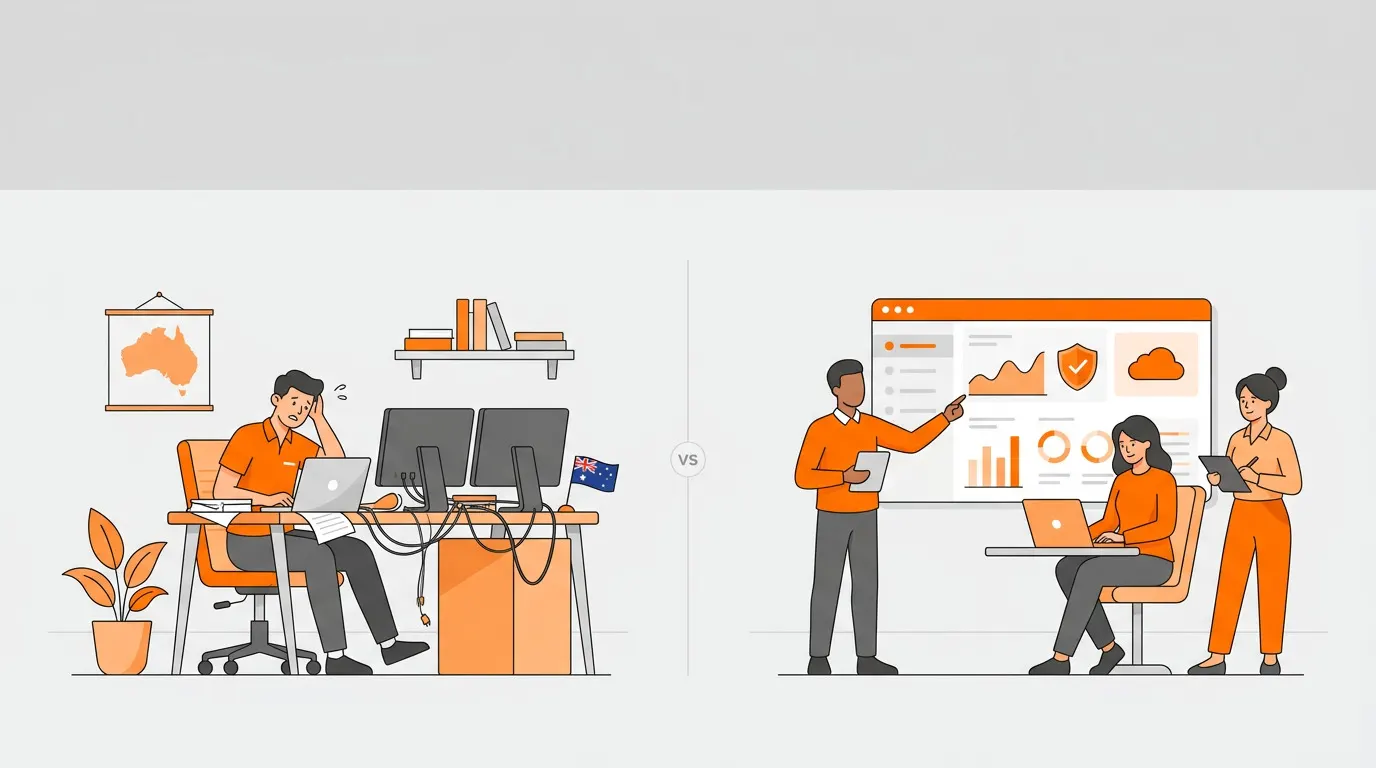
In-House IT Support vs Managed IT Services: Which Is Better for Your Business?
Choosing how to look after your technology is one of the bigger decisions a growing business makes. Do you hire your own person, or partner with a provider? At Nxt IT Solutions, a locally owned Griffith team, we help businesses weigh up both options. This guide compares in-house IT support with managed IT services across cost, coverage, security and flexibility, so you can choose with confidence in 2026.
Quick Answer: Which Is Better?
For most small and mid-sized businesses without a full IT team, managed IT services are usually the better fit, because they offer wider expertise, 24/7 monitoring and predictable costs. In-house IT suits larger organisations with constant, specialised IT demands. Many businesses land on a mix of both.
What Is In-House IT Support?
In-house IT support means employing your own IT staff. They know your people and systems well and can help in person. The trade-off is that one or two employees must cover everything: the help desk, security, projects, leave and after-hours problems.
What Are Managed IT Services?
Managed IT services give you an external team that monitors, maintains, supports and secures your systems for a predictable monthly fee. Good managed IT support combines a help desk, proactive monitoring, patching and backups under one agreement. For a deeper explanation, read our guide to what managed IT services are.
In-House IT vs Managed IT Services: Side-by-Side
| Factor | In-House IT Support | Managed IT Services |
|---|---|---|
| Cost | Salary plus superannuation, leave, training and tools. | Predictable monthly fee, often based on the number of users or devices. |
| Coverage | Usually limited to business hours and affected by staff availability and leave. | Help desk support combined with proactive monitoring. |
| Expertise | Relies on the knowledge and skills of one or a few employees. | Access to a team with different technical skills and specialisations. |
| Security | Depends on the in-house team’s security knowledge, tools and processes. | Access to security tools, monitoring and established security processes, depending on the service agreement. |
| Scalability | Growth may require additional recruitment, training and resources. | Easier to scale support as users, devices and business needs change. |
| Control | Direct control over daily IT operations and internal priorities. | Shared responsibility, guided by agreed service levels and the service agreement. |
What Does Each Option Really Cost?
Salary is only the start of in-house costs. Add superannuation, leave cover, training, software licences, monitoring tools and recruitment, and the true annual cost sits well above the pay packet. Australian guides commonly put experienced IT salaries above $100,000 a year before those extras. There is also the risk of a single point of failure: when your one IT person is sick, on holiday or resigns, support stops.
Managed IT services spread those costs across many clients, giving you a team, tools and monitoring for a fixed monthly fee. Pricing varies by provider and scope, so always ask for an itemised quote that shows exactly what is included.
When In-House IT Makes Sense
An in-house team can be the right call if:
* You have a large workforce with constant, complex IT demands
* You run specialised systems that need someone on site every day
* You have the budget to hire several people, so you are not relying on one
* When Managed IT Services Are the Better Choice
Managed IT services usually win when:
* You have no dedicated IT team, or only one person covering everything
* You want predictable monthly costs instead of surprise invoices
* You need strong protection, including IT security services such as monitoring, backups and multi-factor authentication
* You expect to grow, add sites or move to the cloud
The Hybrid Option: Co-Managed IT
You don’t have to choose one or the other. In a co-managed model, your internal person handles day-to-day requests, while an external provider adds 24/7 monitoring, security, projects and cover during leave. It keeps local knowledge in the business without the single point of failure.
Final Thoughts:
There is no single right answer, but for most businesses without a full IT team, managed IT support offers wider expertise, stronger protection and more predictable costs. If you’re weighing up your options, contact Nxt IT Solutions for a conversation about what suits your business.